Assignment 1 – What is Geospatial Analysis?

A set of techniques for analyzing geospatial data

A set of techniques which results are dependent on the locations of the objects being analyzed

A set of techniques requiring access to both the locations of objects and also to their attributes

(after Goodchild)

Read these three questions:
  1. What is the race composition in Minneapolis?
  2. Is there a segregation between white and non-white neighborhoods in Minneapolis?
  3. What is the average percentage of white population among the Census blocks?
After finish reading the entire page, use the lecture Moodle site to submit your answers to the three questions posted on this page.

The table below lists Census blocks in Minneapolis in a descending order of percentage of white, as recorded in the 2010 Census. Which of the above three questions can be answered with this table?
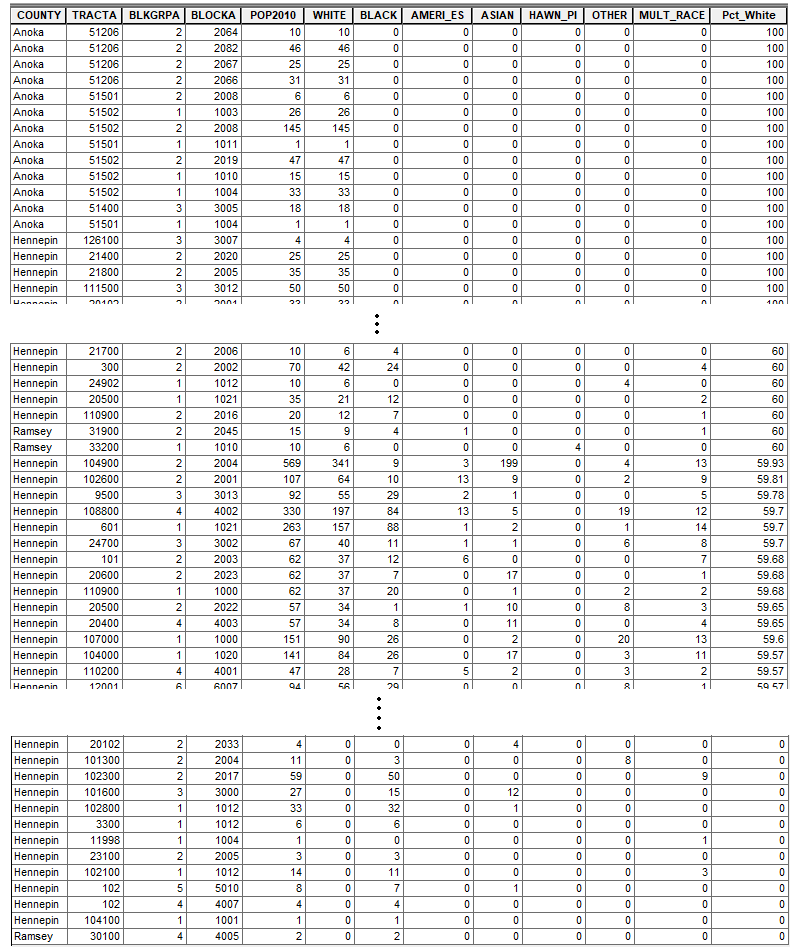
2010 Census Summary File 1 Table P3

The map below is a different presentation/visualization of the same data. Which of the three questions can be addressed with the map?
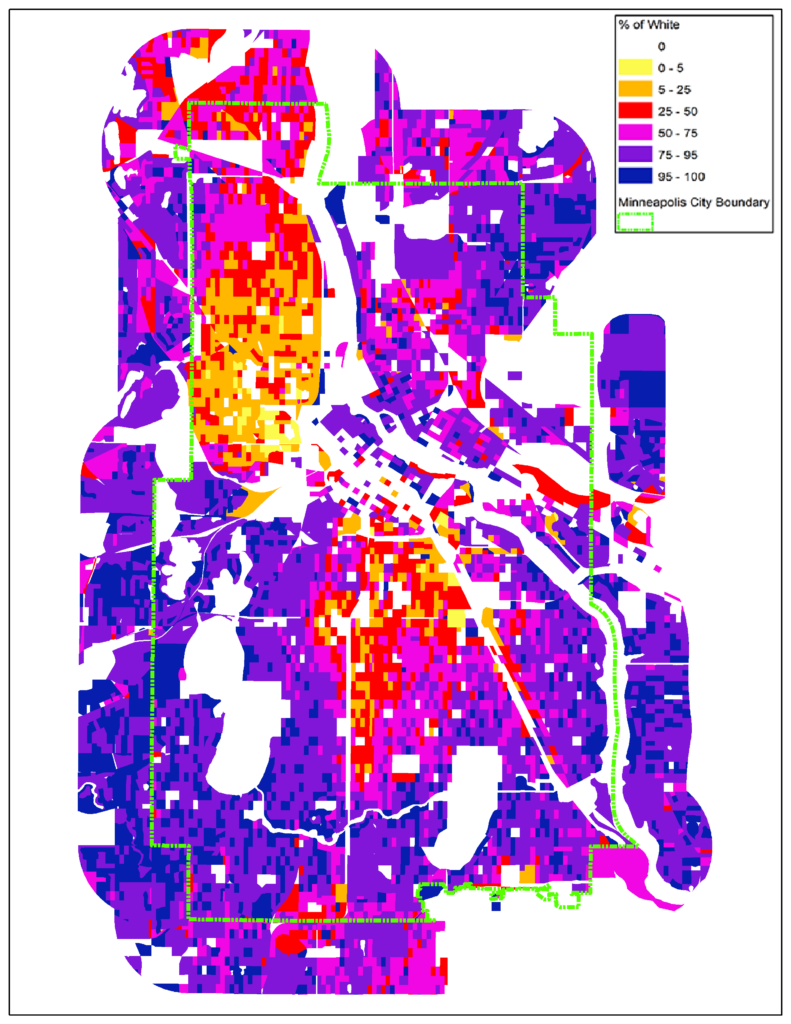
% of White, computed from 2010 Census Summary File 1 Table P3

The exercise hopefully helps you distinguish between geospatial questions and non-geospatial questions. The answers to the former require knowing the locations of the measurements, and answers to the latter do not require knowing the locations of the measurements. Geospatial methods use locations in data visualization, exploration, statistics computation, and modeling. The map above, for example, is a “geospatial” way of visualizing data.

This courses is about addressing geospatial questions. The ability to form an appropriate geospatial question is essential for you to develop your final projects.

To help you see the significance location plays in addressing geospatial questions, the second map is created from the same percentage values,  but the locations of the percentage values are changed by randomly pairing the percentage values with the Census blocks. Which of the three questions would get a different answer with this new map?

% of White, 2010, with locations of the percentage values randomly shuffled using the GeoDa software.